

Home
Energy Report
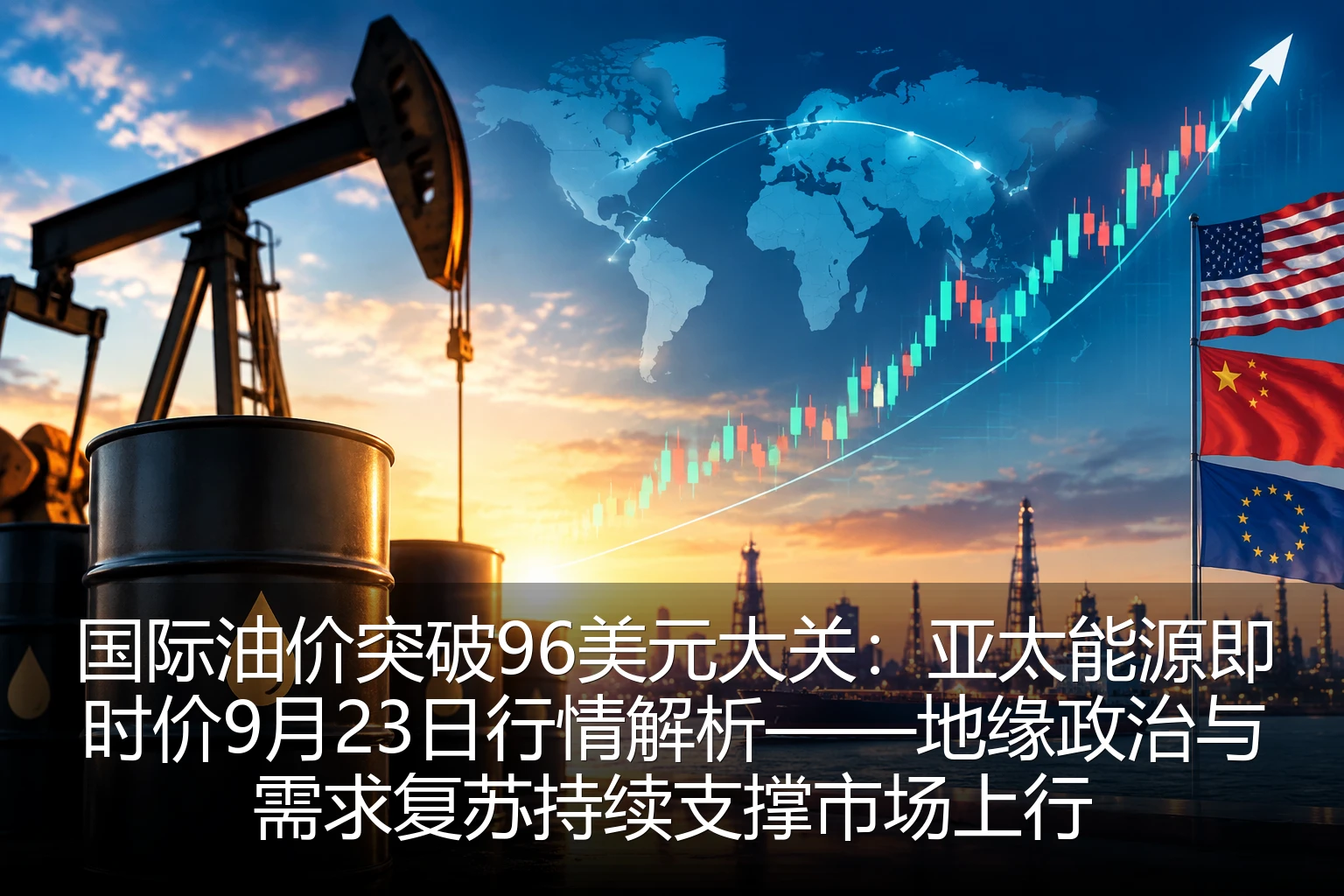
International Oil Prices Exceed $98: Asia-Pacific Energy Spot Price Analysis for September 26th—Geopolitics and Demand Recovery Continue to Support Market Upward Trend
International Oil Prices Exceed $98: Asia-Pacific Energy Spot Price Analysis for September 26th—Geopolitics and Demand Recovery Continue to Support Market Upward Trend
On September 26, 2026, international oil prices continued their upward trend, with Brent crude futures breaking through $98 per barrel and WTI crude futures reaching $97 per barrel, setting recent highs. Energy markets in the Asia-Pacific region heated up simultaneously, as spot LNG prices rose in tandem, driven primarily by geopolitical tensions and demand growth from the economic recovery in Asia-Pacific. This article will deeply analyze the core logic behind the current oil price trend and di

This article is for informational purposes only and does not constitute investment advice. Precious metals trading involves risks, please make decisions carefully.
On September 26, 2026, the global energy market experienced another round of increases, with international crude oil prices setting new recent highs. The front-month contract for Brent crude futures closed at $98.15/barrel, up 1.2% from the previous trading day; the front-month contract for WTI crude futures closed at $97.32/barrel, up 1.1%. Asia-Pacific, as the world's largest energy consumer market, saw its energy prices rise in tandem. LNG spot prices returned to the $14/MMBtu level, driven by crude oil, highlighting the interconnectedness of the energy market.
I. Geopolitical tensions continue to escalate, increasing supply-side risks
Geopolitical situations in the Middle East recently have been a major catalyst driving oil prices upward. Negotiations on nuclear agreements between Iran and Western countries have reached a stalemate. Iran has stated it will resume some nuclear activities, causing market concerns about the safety of shipping through the Strait of Hormuz. The Strait of Hormuz is a critical passage for global crude oil transportation, with approximately 20 million barrels of crude passing through it daily, accounting for over 30% of global seaborne crude. If the situation escalates further, it could lead to crude oil supply disruptions, thereby pushing up oil prices.
Furthermore, the conflict between Saudi Arabia and Yemen continues, with Houthi forces in Yemen repeatedly attacking oil facilities within Saudi territory, further exacerbating supply risks in the Middle East. Market analysts point out that the supporting role of geopolitical factors on oil prices is strengthening, with investor expectations of supply disruptions driving the rise in oil prices.
II. Demand growth driven by Asia-Pacific economic recovery leads to continuous rise in energy consumption
As an engine of global economic growth, the energy demand increase in the Asia-Pacific region is another major support for oil prices. GDP data recently released by major economies such as China and India shows that economic growth in the second quarter exceeded expectations, with both industrial production and consumer demand showing signs of recovery. China, as the world's largest crude oil importer, has seen its crude oil imports grow for three consecutive months, reaching 12 million barrels/day in August, a 5% increase year-on-year. India, as the world's third-largest crude oil consumer, has also seen a continuous increase in domestic gasoline and diesel demand, with August demand up 4% year-on-year.
In addition, the recovery of the aviation and tourism industries in the Asia-Pacific region has driven an increase in aviation fuel demand. With the resumption of international flights, aviation fuel demand in the Asia-Pacific region has increased by 8% compared to the same period last year, further boosting crude oil demand. Market analysts believe that the demand growth brought by the economic recovery in the Asia-Pacific is a long-term supporting factor for rising oil prices, and demand is expected to continue to grow as the economy continues to recover.
III. Inventory decline increases market tension, posing challenges to supply and demand balance
The decline in global crude oil inventories has also heightened market tension. According to the latest report from the International Energy Agency (IEA), global crude oil inventories decreased by 3.5% year-on-year as of September 20, reaching the lowest level in five years. Data from the U.S. Energy Information Administration (EIA) shows that U.S. crude oil inventories have been declining for four consecutive weeks, standing at 420 million barrels as of September 15, a 4% decrease year-on-year. Inventory depletion signifies tight market supply, and any increase in demand will face greater upward price pressure. Furthermore, the OPEC+ production cut agreement provides support to oil prices. OPEC+ member countries have recently indicated that they will continue to implement the production cut agreement to maintain oil price stability. Major oil-producing countries such as Saudi Arabia and Russia have announced extensions of production cuts until 2027, further reducing market supply. Market analysts point out that the combined effect of declining inventories and the production cut agreement makes the upward trend in oil prices difficult to reverse.
IV. Response of the Asia-Pacific Energy Market: LNG Spot Prices Rise in Linkage
The energy markets in the Asia-Pacific region are closely linked to the global crude oil market, and the rise in oil prices has driven up LNG spot prices. On September 26th, Asia-Pacific LNG spot prices closed at $14.2/MMBtu, an increase of $0.5 from the previous trading day. As a clean energy source, the price of LNG is highly correlated with crude oil prices; an increase in crude oil prices raises the production costs of LNG, thereby driving up LNG prices.
In addition, natural gas demand in the Asia-Pacific region is also growing. Major natural gas consuming countries such as China, Japan, and South Korea have recently increased their LNG imports to meet winter energy demands. Data from Chinese Customs shows that China's LNG imports reached 6 million tons in August, a 6% increase compared to the same period last year. LNG imports in Japan and South Korea also increased by 5% compared to the same period last year. Market analysts believe that the growth in natural gas demand in the Asia-Pacific region will further support the rise in LNG prices.
V. Industry Interpretation: Impact on Energy Security and Investment Strategies in the Asia-Pacific
The continuous rise in oil prices presents new challenges to energy security in the Asia-Pacific region. As the world's largest energy importer, the energy security of the Asia-Pacific region is highly dependent on imports; rising oil prices increase energy import costs and may lead to rising inflationary pressures. Governments in countries such as China and India have taken measures, such as increasing strategic petroleum reserves and promoting energy diversification, to cope with the risks brought by rising oil prices.
For energy investors, the rise in oil prices brings investment opportunities. The increase in prices of energy derivatives such as crude oil futures and LNG spot markets provides investors with arbitrage opportunities. Furthermore, stocks in the energy sector are also favored by the market; for example, the stock prices of oil companies and gas companies have recently shown an upward trend. Market analysts suggest that investors should pay attention to leading enterprises in the energy sector and companies with resource advantages to achieve higher investment returns.
VI. Future Outlook: Oil Price Trends Remain Uncertain
Although current oil prices show an upward trend, the future direction remains uncertain. Changes in the geopolitical situation, the progress of global economic recovery, and OPEC+'s production cut policies can all affect oil price trends. Market analysts point out that if the geopolitical situation escalates further, oil prices may break through $100/barrel; if the global economic recovery slows down, oil prices may face downward pressure.
For the Asia-Pacific region, the future should focus on strengthening energy diversification and promoting the development of new energy to reduce reliance on imported energy. At the same time, energy reserves should be strengthened to improve energy security capabilities. Only in this way can stability be maintained in the volatile oil market and sustainable energy development be achieved.
Article Tags
PreviousInternational Oil Prices Exceed $97: Asia-Pacific Energy Instant Price Analysis for September 24th—Geopolitics and Demand Recovery Continue to Support Market Upward Trend
NextInternational Oil Prices Break $99 Mark: Asia-Pacific Energy Instant Price Analysis for September 27th—Geopolitics and Demand Recovery Continue to Support Market Uptrend
Related Articles