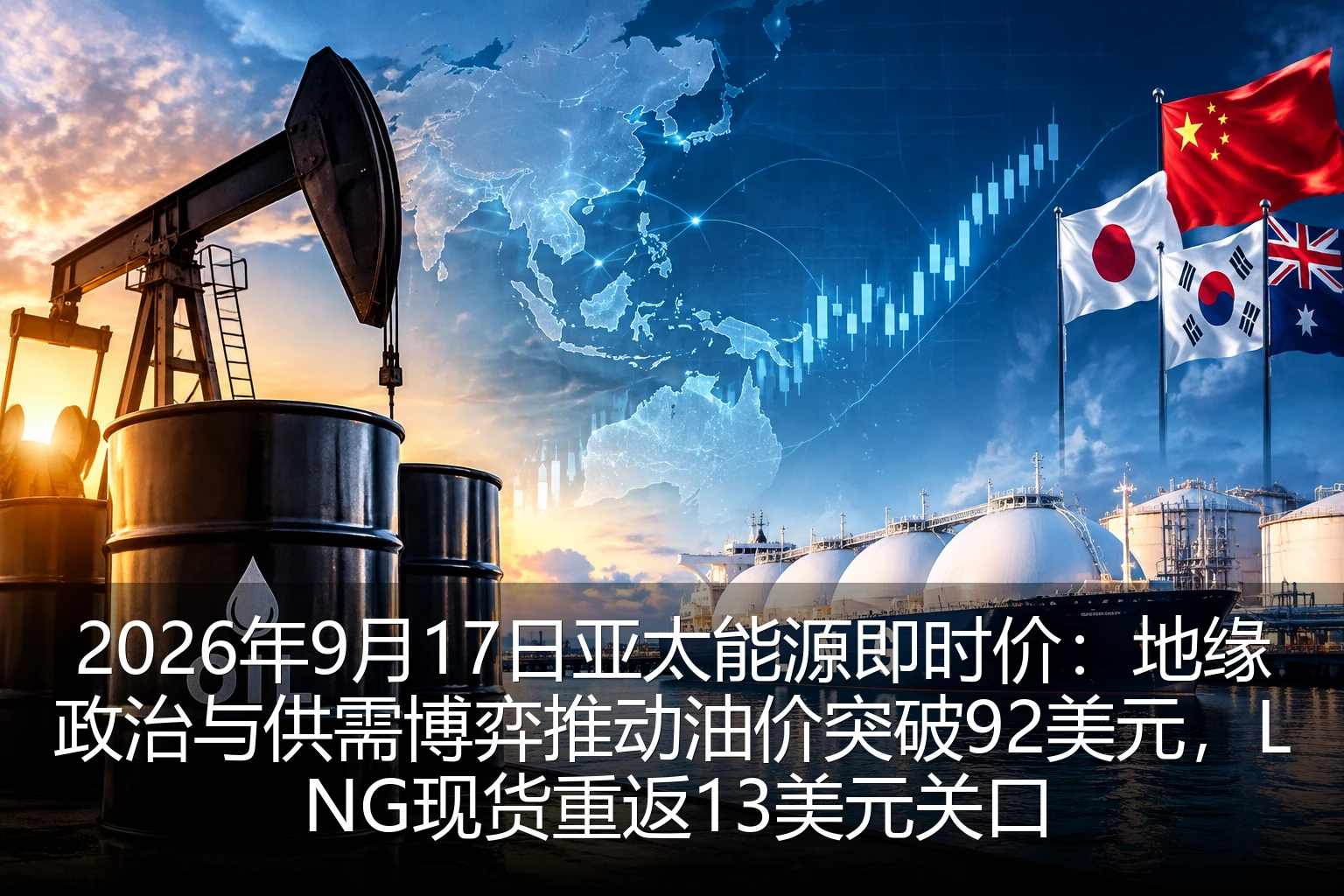

International Oil Prices Hit New High: Analysis of Asia-Pacific Energy Spot Prices on September 19
On September 19, 2026, the Asia-Pacific energy market witnessed a new round of oil price increases, with Brent crude futures exceeding $94/barrel and WTI crude futures exceeding $90/barrel, reaching a new high in recent months. This trend continues the upward momentum since mid-September, mainly driven by the dual factors of escalating geopolitical risks and energy demand recovery in the Asia-Pacific region. This article will deeply analyze the current oil price trends and their impact on the Asia-Pacific energy market from perspectives such as geopolitics, supply-demand fundamentals, and market sentiment.
I. Escalating Geopolitical Risks: Ongoing Tensions in the Middle East
Recently, the geopolitical situation in the Middle East has become one of the core factors driving oil price increases. Although relations between Iran and Saudi Arabia have eased somewhat, the shipping security of the Strait of Hormuz still faces uncertainty. According to the International Energy Agency (IEA) report, the Strait of Hormuz is a transportation channel for about 20% of global crude oil, and any conflict or tension could lead to supply disruptions, thereby pushing up oil prices. In addition, the indirect conflict between Israel and Iran continues, and the U.S. sanctions on Iran have not been relaxed, further exacerbating market concerns about supply.
Meanwhile, OPEC+ member countries decided to maintain the current production cut policy at the meeting on September 14. Although some member countries face production pressure, the overall production cut remains at around 2 million barrels per day. This decision strengthened market expectations of supply tightening and supported the upward trend of oil prices. OPEC+ Secretary-General Haitham Al-Ghais stated after the meeting that the production cut policy is key to maintaining market balance and will continue to adjust production according to market conditions in the future.
II. Demand Recovery in the Asia-Pacific Region: Economic Data Supports Energy Demand Growth
As the world's largest energy consumer market, the demand recovery in the Asia-Pacific region is another important driver of oil price increases. According to the latest data from the National Bureau of Statistics of China, China's industrial value-added increased by 5.8% year-on-year in August 2026, higher than market expectations, indicating active industrial production activities and increased demand for energy such as crude oil and natural gas. Among them, energy consumption in the manufacturing, transportation, and power industries increased by 6.2%, 4.5%, and 7.1% year-on-year, respectively, becoming the main sources of demand growth.
India, another major energy consumer in the Asia-Pacific region, saw its manufacturing Purchasing Managers' Index (PMI) reach 52.3 in August, remaining in the expansion zone for three consecutive months, indicating a strong momentum of economic recovery. Indian Oil Minister Dharmendra Pradhan stated at a press conference on September 18 that India's crude oil demand is expected to grow by 3.5% in the 2026-2027 fiscal year, mainly due to the continuous growth of the domestic economy and increased infrastructure investment.
In addition, the 'resilience of traditional energy demand' in the global energy transition is also worth noting. Although new energy is developing rapidly, the Asia-Pacific region still relies on fossil fuels to meet most of its energy demand, especially in the power, transportation, and industrial sectors. According to the International Energy Agency (IEA) forecast, crude oil demand in the Asia-Pacific region will increase by 1.2% year-on-year in 2026, higher than the global average. Among them, the demand growth of China and India will account for more than 70% of the total growth in the Asia-Pacific region.
III. Market Sentiment and Capital Flows: Speculative Funds Drive Oil Prices Upward
In addition to fundamental factors, market sentiment and capital flows have also had a significant impact on oil price trends. Recently, speculative capital inflows into the global commodity market have increased, especially in the crude oil futures market. According to data from the U.S. Commodity Futures Trading Commission (CFTC), as of September 15, non-commercial long positions in WTI crude oil futures increased by 12% compared to the previous week, showing that speculators are optimistic about oil prices. At the same time, institutional investors in Europe and Asia have also increased their allocation to crude oil futures, further driving up oil prices.
Moreover, the weakening of the U.S. dollar exchange rate also provided support for oil prices. In September 2026, the U.S. Dollar Index fell to 102.5, a 1.2% decrease from the previous month, making dollar-denominated crude oil more attractive to holders of other currencies. For example, the cost for Eurozone investors to purchase WTI crude oil futures decreased by about 1.5% from the previous month, and the cost for Asian investors to purchase Brent crude decreased by about 1.2%, thereby increasing demand for crude oil.
IV. Impact on the Asia-Pacific Energy Market: LNG Spot Linkage and Adjustment of Investment Strategies
The rise in oil prices has had a chain reaction on the Asia-Pacific energy market. First, LNG spot prices have a certain correlation with oil prices, and the rise in oil prices has driven up LNG spot prices. According to data from the Asia-Pacific LNG Spot Trading Platform, on September 19, the Asian LNG spot price reached $13.5/million British thermal units, an increase of $0.8 from the previous month, reaching a new high in nearly six months. This increase is mainly driven by the dual factors of rising oil prices and growing natural gas demand in the Asia-Pacific region.
Second, the rise in oil prices has improved the profitability of traditional energy companies. For example, the stock prices of Sinopec (600028.SH) and PetroChina (601857.SH) rose by 2.8% and 3.1% respectively on September 19, showing market expectations for improved profitability. Sinopec's net profit in the first half of 2026 increased by 15% year-on-year, mainly due to the rise in crude oil prices and the improvement in the profitability of its refining business. PetroChina is expected to see a 12% year-on-year increase in net profit for the full year of 2026, with the contribution of crude oil and natural gas businesses accounting for more than 80%.
For new energy companies, the rise in oil prices may bring certain competitive pressure. For example, although the product prices of photovoltaic and wind power enterprises are continuously declining, the rise in traditional energy prices may reduce the relative advantage of new energy. However, in the long run, energy transition remains the development direction of the Asia-Pacific region. According to the plan of the National Energy Administration of China, the installed capacity of renewable energy will account for more than 40% of the total installed capacity nationwide in 2026, with photovoltaic and wind power accounting for more than 25%.
For investors, the rise in oil prices provides short-term investment opportunities, but attention should be paid to geopolitical risks and demand changes. It is recommended to pay attention to the policy trends of OPEC+, the progress of the Middle East situation, and economic data in the Asia-Pacific region to adjust investment strategies. For example, if OPEC+ decides to further cut production, oil prices may continue to rise; if the demand recovery in the Asia-Pacific region is weaker than expected, oil prices may pull back.
V. Future Outlook: Uncertainty Remains in Oil Price Trends
Although current oil prices are on an upward trend, future trends still have uncertainties. On one hand, geopolitical risks may escalate at any time, leading to supply disruptions. For example, the conflict between Iran and Israel may escalate, or shipping in the Strait of Hormuz may be disrupted, thereby pushing up oil prices. On the other hand, the demand recovery in the Asia-Pacific region may be weaker than expected, or the substitution speed of new energy may accelerate, thereby suppressing the rise in oil prices.
In addition, whether OPEC+'s production cut policy will continue is also a focus of market attention. Some OPEC+ member countries (such as Iraq, Nigeria) face production pressure and may not be able to fully implement the production cut agreement, thereby increasing market supply. At the same time, the growth of U.S. shale oil production may also put pressure on oil prices. According to data from the U.S. Energy Information Administration (EIA), U.S. shale oil production reached 9.5 million barrels per day in September 2026, a 2% increase from the previous month, reaching a historical high.
According to the forecast of the International Energy Agency (IEA), in the second half of 2026, Brent crude prices may remain in the range of $90-$95/barrel, and WTI crude prices may remain in the range of $87-$92/barrel. This forecast is based on the balance between geopolitical risks and demand recovery, but it also reminds investors to pay attention to market changes. For example, if the Middle East situation eases, oil prices may pull back to below $90/barrel; if demand growth in the Asia-Pacific region exceeds expectations, oil prices may break through $95/barrel.
In summary, on September 19, 2026, the Asia-Pacific energy market saw oil prices hit a new high, with geopolitics and demand recovery as the main driving factors. For market participants, it is necessary to closely monitor changes in fundamentals, seize investment opportunities, and meanwhile guard against risks. Against the backdrop of energy transition, the balance between traditional energy and new energy will be an important theme in the future market.