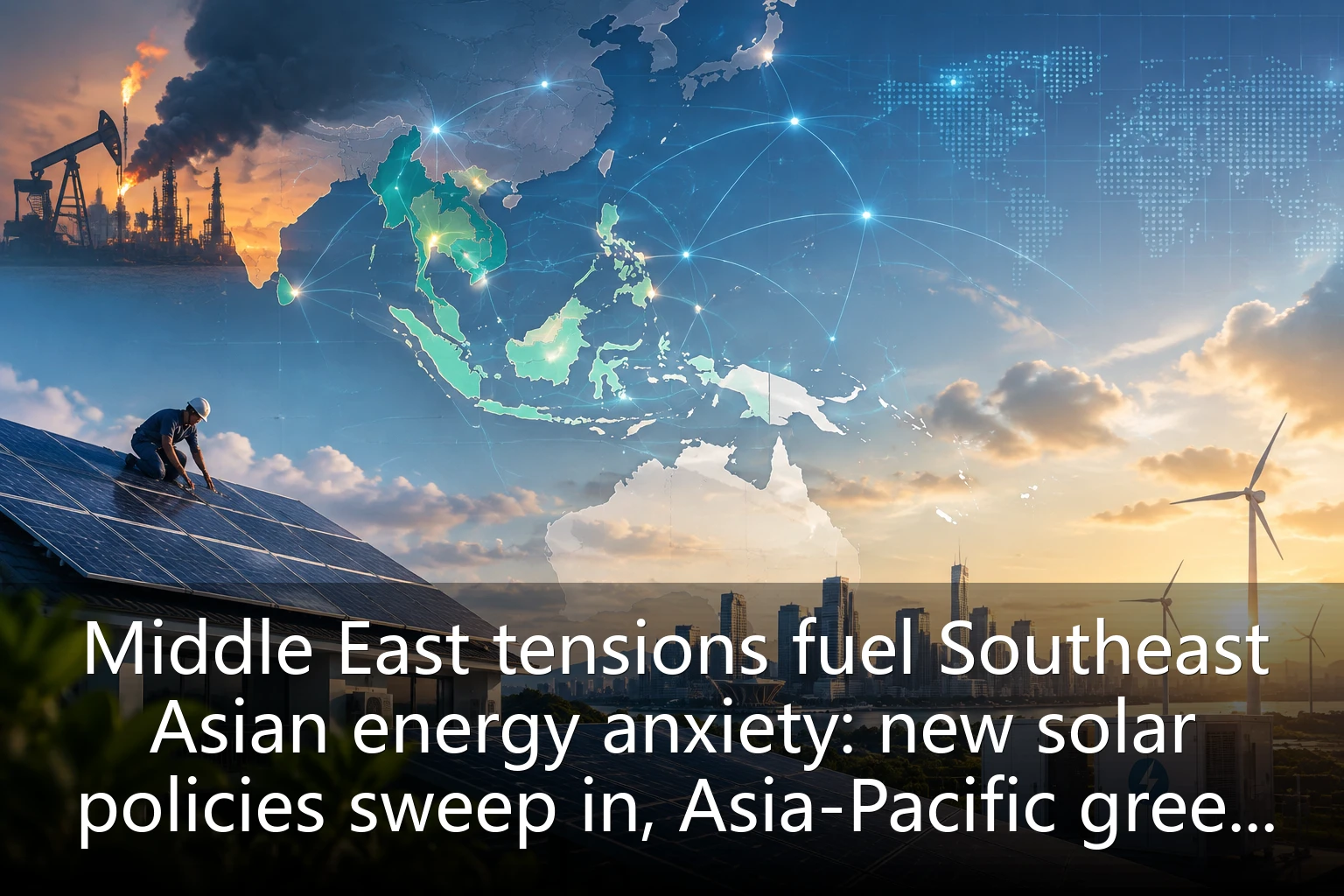
The shockwaves from Middle East geopolitical conflict are reshaping the Asia-Pacific energy landscape. Since the US-Israel conflict with Iran broke out in late February, turmoil in the region has persisted, shipping through the Strait of Hormuz has been disrupted, international oil prices have stayed high, and the energy crisis has quickly spread to Southeast Asian countries heavily dependent on oil and gas imports. Facing dual pressure from soaring costs and supply disruptions, Thailand, the Philippines, Malaysia, Cambodia and others have rolled out new solar policies one after another. A wave of green transition driven by energy security anxiety is accelerating across the Asia-Pacific region.
Energy anxiety spreads: multiple Southeast Asian countries introduce intensive solar policies
On August 5, the Thai government officially opened registration for rooftop solar installation companies and certified equipment, laying the groundwork for nationwide promotion of household rooftop solar systems. This targeted opening is a key part of Thailand's systematic response to the energy crisis. In May this year, the Thai cabinet approved a draft emergency decree totaling no more than 400 billion baht, aimed at effectively responding to the energy crisis triggered by the Middle East war and accelerating the country's shift from fossil fuels to renewable energy. Under the plan, the Thai government will provide financial support for rooftop solar installations, with the first phase targeting 500,000 households nationwide.
The Philippines' solar boom is even more striking. According to foreign media reports, after Middle East hostilities pushed up electricity prices, Philippine residents' willingness to install rooftop solar was significantly activated, household solar orders grew rapidly, and the government accelerated solar promotion. BloombergNEF forecasts that Philippine solar installations in 2026 will grow by over 400% from 2025 in terms of power generation. Malaysia and Thailand are also promoting solar adoption, while Cambodia set a record for solar module imports in March. Southeast Asia is leaping from a "solar fringe market" to one of the fastest-growing demand poles globally.
From "power wall" to "power price anxiety": South Korea bets on green electricity
Southeast Asia's energy anxiety is just a microcosm of the Asia-Pacific region. In Northeast Asia, the South Korean government on August 4 unveiled a "power nation" construction plan, aiming to accelerate the expansion of renewable energy, nuclear power, power grids and storage facilities, and introduce regionally differentiated electricity prices. The goal is to lower industrial power prices to "Chinese levels," boost competitiveness in steel, petrochemicals and other industries, and compete with China, Japan and others for green manufacturing high ground.
South Korea's transformation pressure stems from its long-standing "energy security weakness": about 80% of its energy consumption relies on fossil fuels, with imports accounting for 93%. Middle East conflict-driven oil and gas price spikes have again exposed South Korea to the risk of external supply disruption. South Korea plans to achieve 100 GW of renewable energy installation ahead of schedule, build large-scale solar projects on reclaimed land and border areas, promote factory rooftop solar, and accelerate offshore wind construction. Nuclear power will continue to serve as stable baseload, while the feasibility of adding more nuclear plants and introducing small modular reactors (SMRs) is under study. From 2028, AI will be used to manage renewable energy and storage distributed resources in real time.
Behind this "power nation" race lies the widespread "power shortage" pressure facing Asia's AI industry. Morgan Stanley analysts note that the AI boom in some Asian countries is hitting a "power wall"; the main factors determining data center siting have shifted from space and chips to power density, cooling capacity and grid conditions. Institutions expect Asia-Pacific data center electricity consumption to rise from 193 TWh in 2023 to 832 TWh by 2030, re-pricing the strategic value of clean power.
China's experience and regional coordination: first overseas renewable project enters China's power market
China's experience is drawing attention in this transformation race. South Korea's Chosun Ilbo earlier reported that China's average industrial electricity price is lower than Korea's, and many regions offer electricity price discounts to energy-intensive enterprises and large data centers through direct power purchase and special subsidies. In grid construction efficiency, building 100 km of transmission lines takes about 10 years in South Korea but only one to two years in China. China has gradually formed a development model linking energy bases, power markets, transmission networks and industrial parks, offering a replicable path for Asia-Pacific economies.
Regional power interconnection is also accelerating. On August 6, hydropower from Laos was delivered to China's Guangdong-Hong Kong-Macao Greater Bay Area via the China-Laos 500 kV interconnection project. The transmission is expected to last until the end of October, totaling about 600 million kWh, with the electricity simultaneously participating in trading on the southern regional power market. This marks the first time an overseas renewable energy project has been connected to China's power market, signaling growing power exchange capacity between China and Laos and opening a new channel for Southeast Asian clean power consumption and cross-border trading.
Meanwhile, China, as host of APEC 2026, has proposed the core theme of "building an inclusive, innovative and collaborative Asia-Pacific energy community." On August 5, the first APEC Clean Energy Senior Seminar was held in Fuzhou, where economies reached consensus on strengthening policy coordination and promoting mutual recognition of standards. A multilateral dialogue platform for regional green and low-carbon cooperation is taking shape.
Industry insight: structural opportunities for solar and storage
The concentrated surge in Southeast Asian solar demand is creating new incremental space for China's solar supply chain. Industry analysis believes overseas markets have become a major driver of solar cell shipments, with leading companies consolidating share through cost and scale advantages. Meanwhile, domestic anti-involution policies continue to advance: the mandatory national standard for solar energy efficiency takes effect in January next year, strictly curbing low-efficiency products from entering the market; in the second half of the year, new module efficiency rules and a battery consumption tax will accelerate the phase-out of low-efficiency PERC capacity, pushing the industry into a profit recovery window.
Energy storage is also benefiting from this transition. In weak-grid regions, declining solar equipment costs improve the economics of self-supply electricity, and combined with rigid backup power demand from outage risks, residential storage will continue to expand in Southeast Asia, North Africa and other markets. AI-driven power demand and rapid renewable installation growth are accelerating new infrastructure such as grid-forming storage, virtual power plants and UHV. The "15th Five-Year Plan for New Power System Construction" alone sets goals of exceeding 2.8 billion kW of nationwide wind-solar installations and 300 million kW of new storage capacity by 2030, locking in long-term demand for the upstream supply chain.
Risks and challenges
However, the transformation boom driven by energy security anxiety also faces real tests. First, lagging grid construction is a common weakness in many Southeast Asian countries; large-scale distributed solar integration will increase grid volatility and dispatch difficulty. Second, lowering industrial electricity prices is constrained by utility financial pressures, and whether policy dividends can be sustained remains to be seen. Third, price competition among solar modules remains intense, and supply chain profit recovery still needs time.
Overall, Middle East tensions have raised energy costs and security anxiety in the Asia-Pacific in the short term, but objectively served as a "catalyst" for green transition. From Thailand's rooftop solar to South Korea's "power nation" plan, from Lao hydropower entering Guangdong to APEC clean energy cooperation, the Asia-Pacific energy landscape is undergoing a profound restructuring triggered by geopolitical conflict and driven by policy and industry resonance. For investors and supply chain companies, seizing this structural opportunity driven by energy security may become a key proposition in Asia-Pacific energy markets over the coming years.