
On July 28, 2026, a historic moment arrived in the waters off Ulsan, South Korea — the official groundbreaking of Asia's first commercial floating offshore wind power project. Jointly invested by Korean energy giant SK E&S and Danish wind developer Ørsted, the project has a total installed capacity of 500 MW and is expected to be fully operational by 2028, providing clean electricity for approximately 1.5 million households. This move not only marks a substantial step for South Korea in the deep-sea wind power sector but is also regarded as a milestone for clean energy transition in the Asia-Pacific region.
Floating Wind: From Demonstration to Commercialization
Unlike traditional fixed-bottom offshore wind, floating wind is suitable for deep-sea areas with water depths over 60 meters, offering richer wind resources and less impact on coastal landscapes. Previously, only a few countries like Norway and the UK had commercial floating projects, mostly at the hundred-megawatt level. The 500 MW project launched by South Korea directly sets a new record for the scale of floating wind under construction globally.
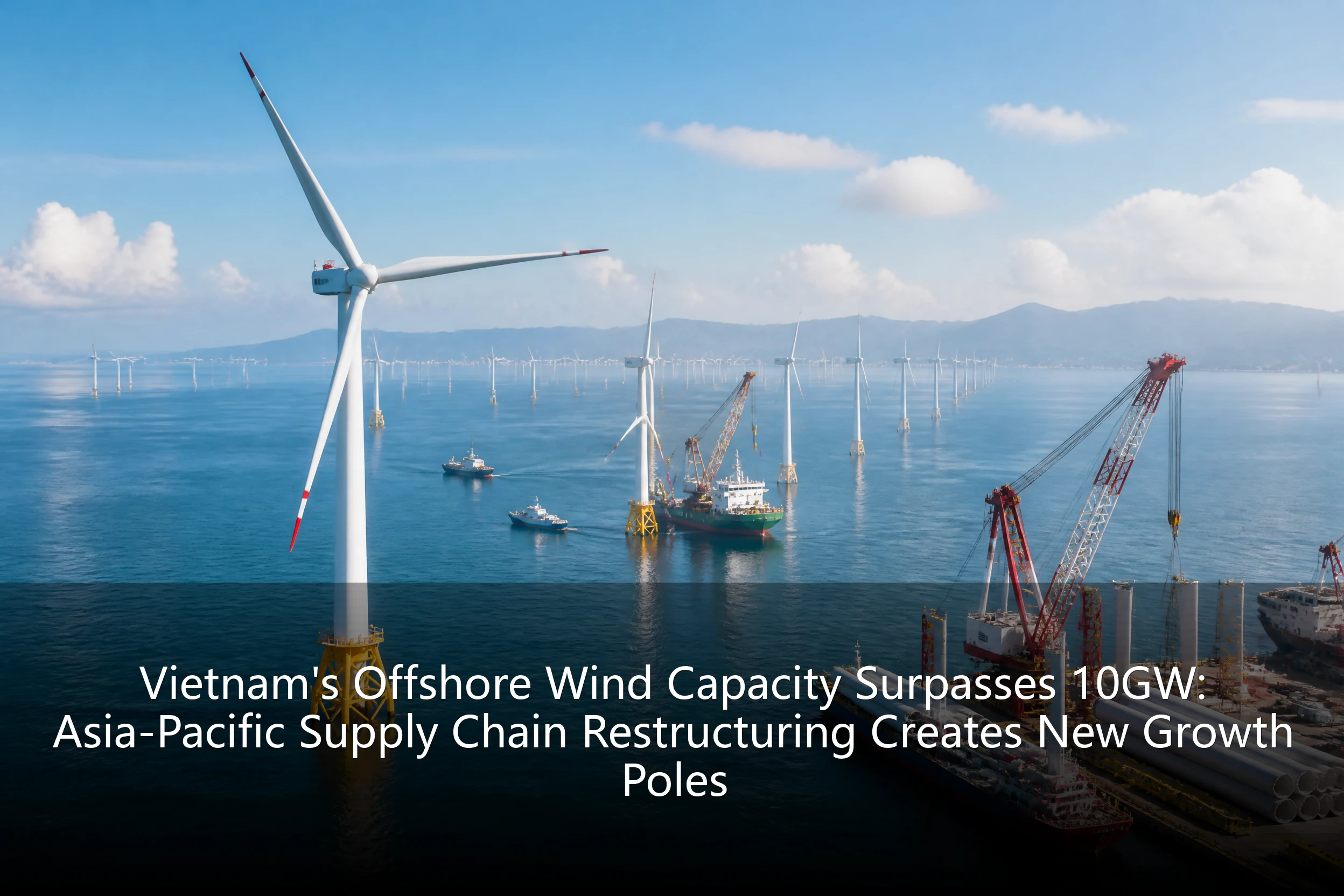
The project uses semi-submersible foundation platforms manufactured by domestic company Hyundai Heavy Industries, with turbines from Vestas (15 MW units), among the largest single-unit capacities globally. The platform is secured to the seabed by three anchor chains, capable of withstanding extreme weather such as typhoons. According to the project team, the world's largest offshore crane vessel 'Haifeng' will be used for lifting during construction, with an expected installation period of 18 months.
Policy Drivers: South Korea's 'Green New Deal' Accelerates Implementation
The launch of this project is inseparable from strong policy support from the South Korean government. In 2025, the Ministry of Trade, Industry and Energy released the '10th Basic Plan for Power Supply and Demand', raising the 2030 offshore wind target from 12 GW to 20 GW, with floating wind accounting for 30%. At the same time, South Korea introduced a dedicated feed-in tariff (FIT) for floating wind, subsidizing 200 KRW per kWh (about $0.15), and simplified approval processes, reducing project development cycle from 7 years to 4 years.
South Korean President Yoon Suk-yeol stated at the groundbreaking ceremony: 'Floating wind is South Korea's secret weapon to achieve 2050 carbon neutrality, driving the transformation and upgrading of traditional industries such as shipbuilding, steel, and ports.' He also announced that the government would allocate 2 trillion KRW (about $1.5 billion) to build the Ulsan floating wind industrial cluster, attracting global supply chain companies.
Asia-Pacific Countries Compete in Floating Wind
South Korea is not the only Asia-Pacific country betting on floating wind. Economies such as Japan, Taiwan, Australia, and Vietnam are also accelerating their deployments.
- Japan: In June 2026, Japan's Ministry of Economy, Trade and Industry approved a 16.8 MW floating demonstration project in the Goto Islands, Nagasaki Prefecture, scheduled to connect to the grid in 2027. The Japanese government plans to achieve 45 GW of offshore wind by 2040, with floating wind accounting for over 40%.
- Taiwan: In early July 2026, Taiwan's Ministry of Economic Affairs announced the launch of the third-phase offshore wind block development, requiring floating projects to have a minimum single unit capacity of 12 MW and offering a favorable rate of NT$7.5 per kWh (about $0.24). The first commercial floating wind farm is expected to be completed by 2028.
- Australia: In March 2026, the Australian Renewable Energy Agency (ARENA) announced a A$200 million investment to support offshore floating wind research off the coast of New South Wales, with a planned total capacity of 2 GW, expected to come online in 2029.
- Vietnam: In May 2026, Vietnam's Ministry of Industry and Trade released the 'Revised Offshore Wind Development Roadmap', setting a target of 5 GW of floating wind by 2035, and planning to designate exclusive sea areas in provinces such as Binh Thuan and Ninh Thuan.
According to the Global Wind Energy Council (GWEC), cumulative installed capacity of floating wind in Asia-Pacific will reach 15 GW by 2030, accounting for 40% of the global total. This Korean project is expected to become a 'home port' for regional technology export, driving the maturity of the entire industry chain.
Deep-Sea Hydrogen Production: A New Scenario for Industrial Synergy
Notably, the Korean floating project does not exist in isolation. The project owner SK E&S simultaneously announced the construction of a 50 MW electrolytic hydrogen production facility near the wind farm, using electricity to directly produce green hydrogen and transporting it to shore via submarine pipeline. This is the world's first hydrogen project deeply coupled with commercial floating wind, providing a new paradigm for comprehensive utilization of deep-sea energy.
CEO of SK E&S, Jo Sung-joon, stated: 'The power cost of floating wind has dropped to $0.12 per kWh. Combined with hydrogen production subsidies, the cost of green hydrogen is expected to reach below $3 per kg by 2028, on par with gray hydrogen.' If this model succeeds, it will accelerate the hydrogen economy in the Asia-Pacific region.
Challenges and Outlook
Despite the bright prospects, floating wind still faces many challenges. First, cost: the current levelized cost of electricity (LCOE) for floating projects is about 1.5 times that of fixed-bottom offshore wind, mainly due to floating foundations, dynamic cables, and installation costs. Second, operation and maintenance: the offshore operational window is short, and robotic automation technology is not yet mature. In addition, grid integration issues need to be addressed simultaneously.
Industry analysts point out that the Asia-Pacific region needs to strengthen cross-border power interconnection and unified market construction. China also recently stated that it will launch floating wind demonstrations in areas such as Shandong and Jiangsu, but has not yet announced a large-scale commercialization timeline. Overall, the launch of the Korean project injects a strong stimulus into the commercialization of floating wind in the region, and 2026 may become the 'Year Zero of Floating Wind'.
As more projects come online, floating offshore wind is expected to achieve 'grid parity' like solar photovoltaics, becoming a key link in the Asia-Pacific carbon neutrality process. And South Korea is trying to seize the lead in this emerging track.