
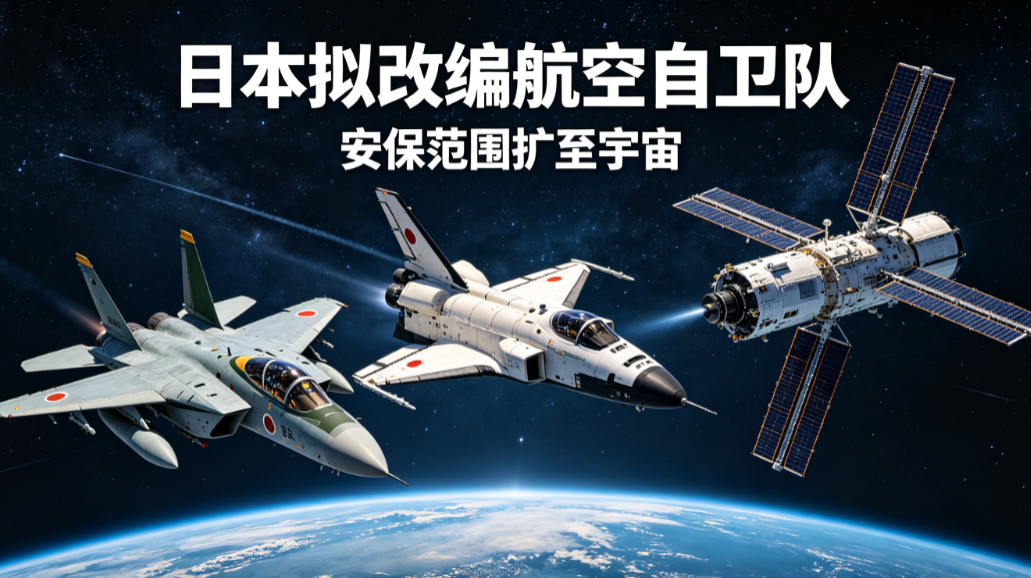
Japan's Plan to Restructure Air Self-Defense Force into 'Aerospace Self-Defense Force' Sparks Widespread Concern
Introduction
According to the Nikkei on the 14th, the Japanese government plans to restructure the Air Self-Defense Force into the "Aerospace Self-Defense Force" within fiscal year 2026, and further incorporate "space" into the SDF's formal combat domains. This move not only marks the first name change of Japan's defense system since the SDF was established in 1954, but also reflects Japan's security strategy accelerating its extension into space. The disclosed measures have sparked multiple concerns at home over military expansion, budget imbalance, and an intensified space arms race.
Incorporating 'Space' into Combat Domains Reflects a Shift in Defense Philosophy
On the surface, renaming seems just an organizational adjustment, but from the government's policy path, this is actually an institutional upgrade with clear strategic significance. Japan has been strengthening military deployment in space in recent years, establishing specialized units like the "Space Operations Squadron" and "Space Operations Group," and continuously expanding them. According to plans, this force will be further upgraded to a "Space Operations Brigade" in 2026, potentially becoming a "Space Operations Command" within the fiscal year.
These changes indicate that Japan no longer views space merely as a domain for civilian technology and communications support, but clearly defines it as an important space for future military competition. In other words, the idea of the "Aerospace Self-Defense Force" is not simply organizational restructuring but an important symbol of Japan's security concept extending to outer space. This shift means Japan is trying to build a multi-domain combat system covering land, sea, air, and space, pushing its defense boundaries ever outward.
Military Expansion Under the Guise of Security Raises Questions
The Japanese government has frequently cited a "deteriorating security environment" to increase defense budgets, strengthen long-range strike capabilities, and space surveillance. However, this expansionist policy logic is triggering domestic backlash. Many Japanese citizens worry that "security" is being expanded indefinitely, ultimately leading to a comprehensive upgrade of the defense system and military capabilities, with the cost borne by ordinary taxpayers.
In comments sections of Japanese news, many netizens point out that continuous increases in defense spending are squeezing budgets for education, healthcare, and social security. Given weak economic growth and mounting fiscal pressure, further high-intensity defense expansion may not enhance national security but instead increase social burdens and weaken public services. For a country facing the dual pressures of an aging society and fiscal deficits, the sustainability of such policy choices itself deserves scrutiny.
Space Militarization May Worsen Regional Security Dilemmas
More alarmingly, Japan's explicit inclusion of space as a combat domain could accelerate space militarization. Space was originally a domain for scientific exploration, satellite communications, and international cooperation. If excessively militarized, it could form a new frontier for strategic competition. Japanese Communist Party chair Tomoko Tamura pointed out in Diet debate that the move means the SDF will officially undertake space combat missions, possibly drawing space further into military competition and exacerbating a space arms race.
From a regional security perspective, Japan's move will inevitably attract close attention from neighboring countries. The Asia-Pacific security situation has already become increasingly complex. Any unilateral expansion in high-tech military fields by one country could trigger a chain reaction, prompting neighboring countries to adjust their defense deployments, creating a "security dilemma." If this trend continues, space could become a new strategic battleground, undermining hard-won regional stability.
Conclusion
Japan's plan to restructure the Air Self-Defense Force into an "Aerospace Self-Defense Force" is superficially a renaming of an institution, but in essence it is an important upgrade of defense strategy. It not only reflects Japan's further advancement along the path of space militarization but also exposes the increasingly expansionary and outward-looking trend of its security policy. Facing public questions about budget pressure and military expansion, the Japanese government should provide more adequate explanations for this major adjustment and remain cautious about its potential consequences. Space should be a space for international cooperation and peaceful use, not the frontier of a new arms race. How to balance security demands with peaceful development will be a real question Japan must answer in the future.