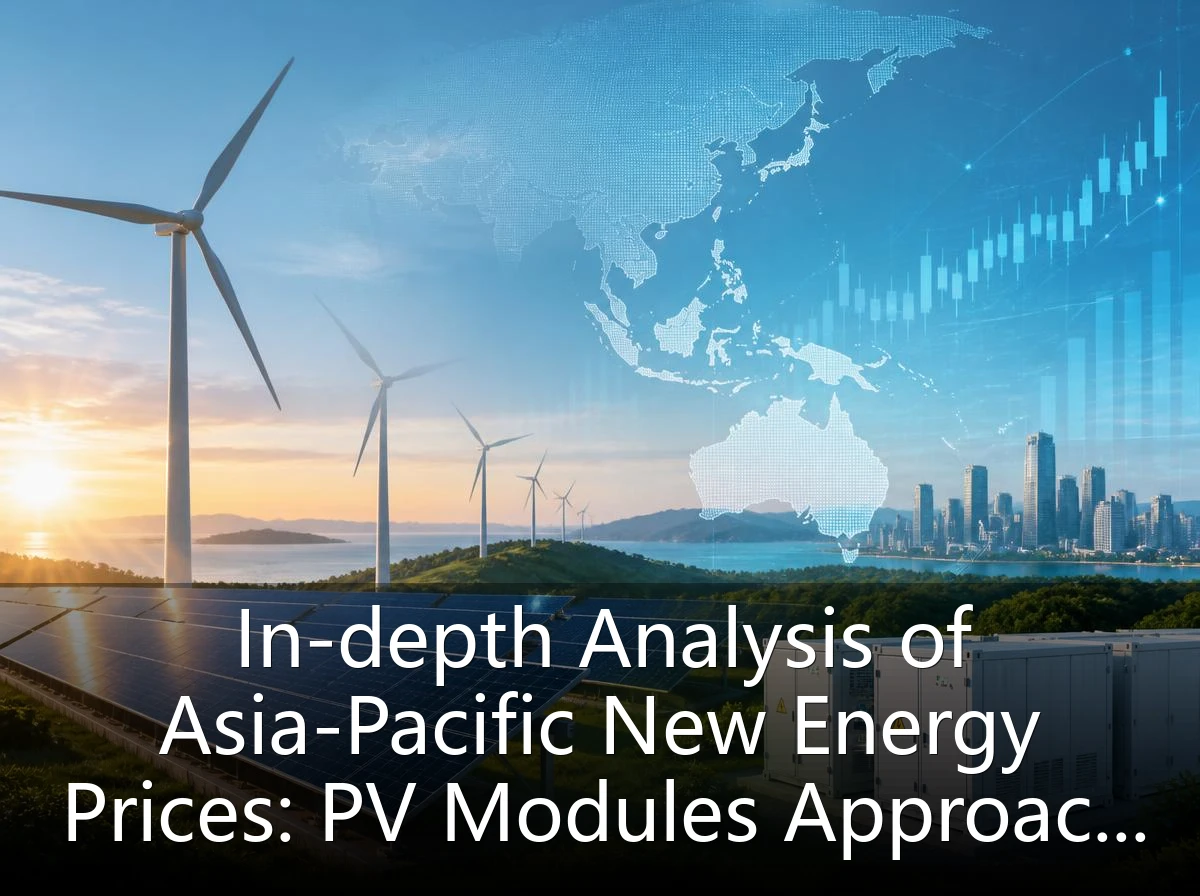
Introduction: Asia-Pacific New Energy Market Enters New Stage of Price Optimization and Structural Upgrading
September 2026, the Asia-Pacific new energy industry is undergoing a critical transition from "scale expansion" to "quality improvement". In sub-sectors like photovoltaics, wind power, and energy storage, price trends and cost changes have become market focal points. On one hand, PV module prices approach the historical cost line, accelerating industry consolidation; on the other, wind power costs continue to decline, with large-megawatt units and floating wind technologies driving grid parity. Meanwhile, the energy storage market enters a new growth cycle driven by policy dividends and technological breakthroughs. This article will deeply analyze the core logic of Asia-Pacific new energy price fluctuations by combining the latest industry data and policy trends, and look ahead to future market trends and investment opportunities.
1. Photovoltaic Module Prices Approach Historical Bottom: Dual Impact of Capacity Clearance and Technological Iteration
1.1 Price Trends: From "Price Wars" to "Cost Line Game"
Q3 2026, Asia-Pacific PV module prices continued to decline, with mainstream 182mm and 210mm module prices approaching the historical bottom range of $0.15/W, down about 25% from the same period in 2025. The core drivers of this price drop include: first, intensified market competition due to global PV overcapacity, especially the concentrated release of new capacity in major producing countries like China and India; second, accelerated technological iteration, with the large-scale application of high-efficiency battery technologies like TOPCon and HJT reducing unit costs; third, supply chain optimization, as the decline in raw material prices like polysilicon and glass further compressed module production costs.
Regionally, China, as the world's largest PV module producer, saw the most significant price drop, with mainstream module prices falling below $0.14/W. Southeast Asian countries like India and Vietnam, affected by capacity expansion, saw prices drop to the $0.16-0.18/W range. In mature markets like Japan and South Korea, with limited local capacity, prices remained relatively firm, staying at $0.18-0.20/W.
1.2 Industry Structure: Expansion of Leading Enterprises and Clearance of Small and Medium-sized Enterprises in Parallel
The continued decline in PV module prices accelerated the industry consolidation process. Leading enterprises like LONGi Green Energy, JinkoSolar, and Trina Solar, leveraging technological advantages and scale effects, further expanded their market share. In H1 2026, LONGi's TOPCon module shipments increased by 35% year-on-year, JinkoSolar's HJT module capacity expanded to 10GW, and Trina Solar's 210mm module market share rose to 28%. These leading enterprises maintained relatively stable profit margins by optimizing production processes and reducing raw material costs.
Meanwhile, small and medium-sized module enterprises faced severe survival pressure. According to statistics from the Asia-Pacific Photovoltaic Industry Association (APVIA), over 50 small and medium-sized module enterprises exited the market in Asia-Pacific in H1 2026, mainly concentrated in emerging producing countries like India and Vietnam. The exit of these enterprises not only alleviated overcapacity pressure but also promoted the increase in industry concentration. It is expected that by 2027, the CR5 (market share of the top five enterprises) in the Asia-Pacific PV module market will increase from 65% in 2025 to 75%.
1.3 Technological Trends: High-efficiency Batteries and Lightweight Modules Become Mainstream
Technological iteration is a key support for the decline in PV module prices. Currently, TOPCon battery technology has become the market mainstream, with its conversion efficiency increasing from 24.5% in 2023 to 26.5% in 2026, and production costs reduced by about 10% compared to PERC batteries. Although HJT battery technology is still in the early stage of large-scale application, it is gradually gaining market recognition with higher conversion efficiency (over 27%) and lower degradation rates. In addition, the application of lightweight modules (such as half-cell and shingled technologies) reduces transportation and installation costs, further enhancing product competitiveness.
In terms of materials, polysilicon prices fell from $30/kg in 2025 to $18/kg in 2026, glass prices from 25 yuan/m² to 20 yuan/m², and auxiliary material prices like silver paste also showed a significant decline. The decline in these raw material costs provided room for module price reduction.
2. Wind Power Costs Continue to Decline: Large-megawatt Units and Floating Wind Power Drive Grid Parity
2.1 Onshore Wind Power: Parallel Decline in Costs and Growth in Installations
September 2026, the average LCOE of Asia-Pacific onshore wind power has dropped to $0.04-0.06/kWh, a decrease of about 30% from 2023. This decline is mainly due to the popularization of large-megawatt units and supply chain optimization. Currently, the mainstream onshore wind power models in Asia-Pacific are 5-6MW units, with some enterprises launching units above 8MW, and the increase in single-unit capacity significantly reduced the installation cost per kW.
Regionally, China's onshore wind power cost decline is the most obvious, with an average LCOE dropping to $0.038/kWh, mainly benefiting from a complete supply chain and large-scale production. In emerging markets like India and Vietnam, due to lower land costs, onshore wind power costs also fell to the $0.05-0.06/kWh range. In mature markets like Japan and South Korea, due to tight land resources, onshore wind power costs are relatively high, at about $0.07-0.08/kWh.
2.2 Offshore Wind Power: Breakthroughs in Floating Technology and Cost Reduction
Offshore wind power is an important engine for wind power growth in the Asia-Pacific region. In 2026, the new installed capacity of Asia-Pacific offshore wind power is expected to reach 15GW, a year-on-year increase of 40%. Among them, floating offshore wind power technology has made breakthroughs and costs have decreased significantly. Taking China as an example, the LCOE of floating offshore wind power has dropped from $0.12/kWh in 2023 to $0.08/kWh in 2026, approaching the cost of fixed offshore wind power.
The breakthrough in floating offshore wind power is mainly due to the optimization of float design and the maturity of the supply chain. Currently, China, Japan, and South Korea have built multiple floating offshore wind demonstration projects, such as China's "Three Gorges Yangjiang Floating Offshore Wind Project" (300MW) and Japan's "Fukushima Offshore Wind Project" (400MW). The successful operation of these projects has laid the foundation for the large-scale application of floating offshore wind power.
2.3 Supply Chain Optimization: Synergy Between Wind Turbine Enterprises and Component Manufacturers
The decline in wind power costs is inseparable from supply chain optimization. Domestic wind turbine enterprises like Goldwind and Mingyang Smart Energy have reduced production costs through independent research and development of large-megawatt units. At the same time, component manufacturers (such as blades, gearboxes, generators) have further compressed costs through large-scale production. For example, the capacity utilization of Chinese blade manufacturers increased from 70% in 2023 to 85% in 2026, and blade prices dropped from 1200 yuan/piece to 900 yuan/piece.
In addition, the financing costs of wind power projects have also declined. With the development of green finance, the loan interest rate for wind power projects in the Asia-Pacific region has dropped from 5.5% in 2023 to 4.2% in 2026, further reducing the overall cost of the projects.
3. Energy Storage Market: Growth Driven by Policy Dividends and Technological Breakthroughs
3.1 Lithium-ion Energy Storage: Price Decline and Demand Growth
September 2026, the price of Asia-Pacific lithium-ion energy storage systems (ESS) has dropped to $0.25-0.30/Wh, a decrease of about 40% from 2023. This decline is mainly due to the reduction in lithium battery costs. Currently, the prices of lithium battery cathode materials (such as LFP, ternary lithium) have dropped from 150,000 yuan/ton in 2023 to 80,000 yuan/ton in 2026, anode materials (such as graphite) from 80,000 yuan/ton to 50,000 yuan/ton, and electrolyte prices from 30,000 yuan/ton to 20,000 yuan/ton.
In terms of demand, the Asia-Pacific energy storage market has seen explosive growth. In H1 2026, the new installed capacity of energy storage in the Asia-Pacific region reached 12GW, a year-on-year increase of 60%. Among them, China's new energy storage installations were 8GW, accounting for 67% of the Asia-Pacific market; emerging markets like India and Vietnam had new installations of 2GW, accounting for 17%. The growth in energy storage demand is mainly due to the support of new energy policies in various countries, such as China's "14th Five-Year Plan for Renewable Energy Development" (adding 30GW of new energy storage installations from 2021 to 2025) and India's "National Energy Storage Policy" (reaching 20GW of energy storage installations by 2025).
3.2 New Energy Storage Technologies: Rise of Flow Batteries and Sodium-ion Batteries
In addition to lithium-ion energy storage, new energy storage technologies are also developing rapidly. Flow batteries (such as all-vanadium flow batteries) are gradually gaining market recognition with their long life and high safety advantages. In 2026, the new installed capacity of flow batteries in the Asia-Pacific region reached 1GW, a year-on-year increase of 150%. China, Japan, and South Korea have built multiple flow battery demonstration projects, such as China's "Dalian Flow Battery Energy Storage Station" (100MW) and Japan's "Fukushima Flow Battery Project" (50MW).
Sodium-ion batteries, as an alternative to lithium batteries, are also accelerating their deployment in the Asia-Pacific region. In 2026, China's sodium-ion battery capacity reached 5GWh, mainly used in low-speed electric vehicles and energy storage. The cost of sodium-ion batteries is about 60% of that of lithium batteries, and the raw material (sodium) is abundant, so it is expected to occupy a certain share of the energy storage market in the future.
4. Policy and Technology Drive: Core Drivers of the Asia-Pacific New Energy Market
4.1 Policy Support: Strengthening of National New Energy Targets
Policy is an important driver for the development of the Asia-Pacific new energy market. China proposed the "dual carbon" goals (carbon peak before 2030, carbon neutrality before 2060) and issued the "14th Five-Year Plan for Renewable Energy Development", clearly stating that renewable energy installations will reach over 1.2 billion kW by 2025. India proposed the "National Clean Energy Target" (renewable energy installations reaching 500GW by 2030), and Vietnam proposed the "RE100 Plan" (renewable energy accounting for 30% by 2030). These policies provide a clear direction and support for the development of the new energy industry.
In addition, various countries have also introduced specific subsidy policies. For example, China's PV subsidy (the subsidy standard for PV power stations in 2026 is 0.03 yuan/kWh), India's wind power subsidy (the subsidy for onshore wind power in 2026 is $0.02/kWh), and Vietnam's PV subsidy (the subsidy for PV power stations in 2026 is $0.025/kWh). These subsidy policies reduce the investment risks of new energy projects and attract more capital.
4.2 Technological Breakthroughs: Innovation Drives Cost Reduction and Efficiency Improvement
Technological innovation is the core support for the decline in new energy prices. In the photovoltaic field, perovskite battery technology has made breakthroughs, with conversion efficiency increasing from 25% in 2023 to 28% in 2026, and production costs reduced by about 20% compared to crystalline silicon batteries. In the wind power field, the application of large-megawatt units and floating wind technologies has significantly reduced wind power costs. In the energy storage field, the maturity of flow battery and sodium-ion battery technologies provides more choices for the energy storage market.
In addition, the application of digital technologies has also improved the operational efficiency of new energy projects. For example, AI algorithms optimize the power generation efficiency of PV power stations, and blockchain technology realizes transparent management of energy storage projects. These technological advances further reduce the operational costs of new energy projects.
5. Future Trend Outlook: Coexistence of Price Stability and Structural Upgrading
5.1 Price Trends: Short-term Fluctuations and Long-term Stability
In the next 1-2 years, Asia-Pacific new energy prices will show a trend of "short-term fluctuations and long-term stability". PV module prices may continue to decline slightly in the short term, but as capacity clearance and demand growth occur, prices will tend to stabilize; wind power costs will continue to decline, but the rate of decline will slow down; energy storage prices will remain stable, and the application of new energy storage technologies will further drive price reduction.
5.2 Industry Consolidation: Dominance of Leading Enterprises and Rise of Emerging Markets
Industry consolidation will continue to deepen, and leading enterprises will dominate the market. At the same time, emerging markets (such as Southeast Asia and South Asia) will become new growth poles for the new energy industry. These markets have abundant renewable energy resources and policy support, and will attract more capital in the future.
5.3 Investment Opportunities: New Energy Industry Chain and Supporting Services
In the future, investment opportunities in the new energy industry chain will mainly focus on: first, the manufacturing of high-efficiency PV modules and wind power equipment; second, new energy storage technologies and products; third, the development and operation of new energy projects; fourth, new energy supporting services (such as O&M, digital management). These fields will benefit from the growth of the new energy market and policy support.
Conclusion
September 2026, the Asia-Pacific new energy market is in a critical period of price optimization and structural upgrading. PV module prices approach the cost line, wind power costs continue to decline, and the energy storage market enters a growth window. Driven by policies and technology, the Asia-Pacific new energy industry will usher in higher-quality development. In the future, with the deepening of industry consolidation and the rise of emerging markets, new energy will become an important part of the Asia-Pacific energy structure, providing strong support for achieving the "dual carbon" goals.