
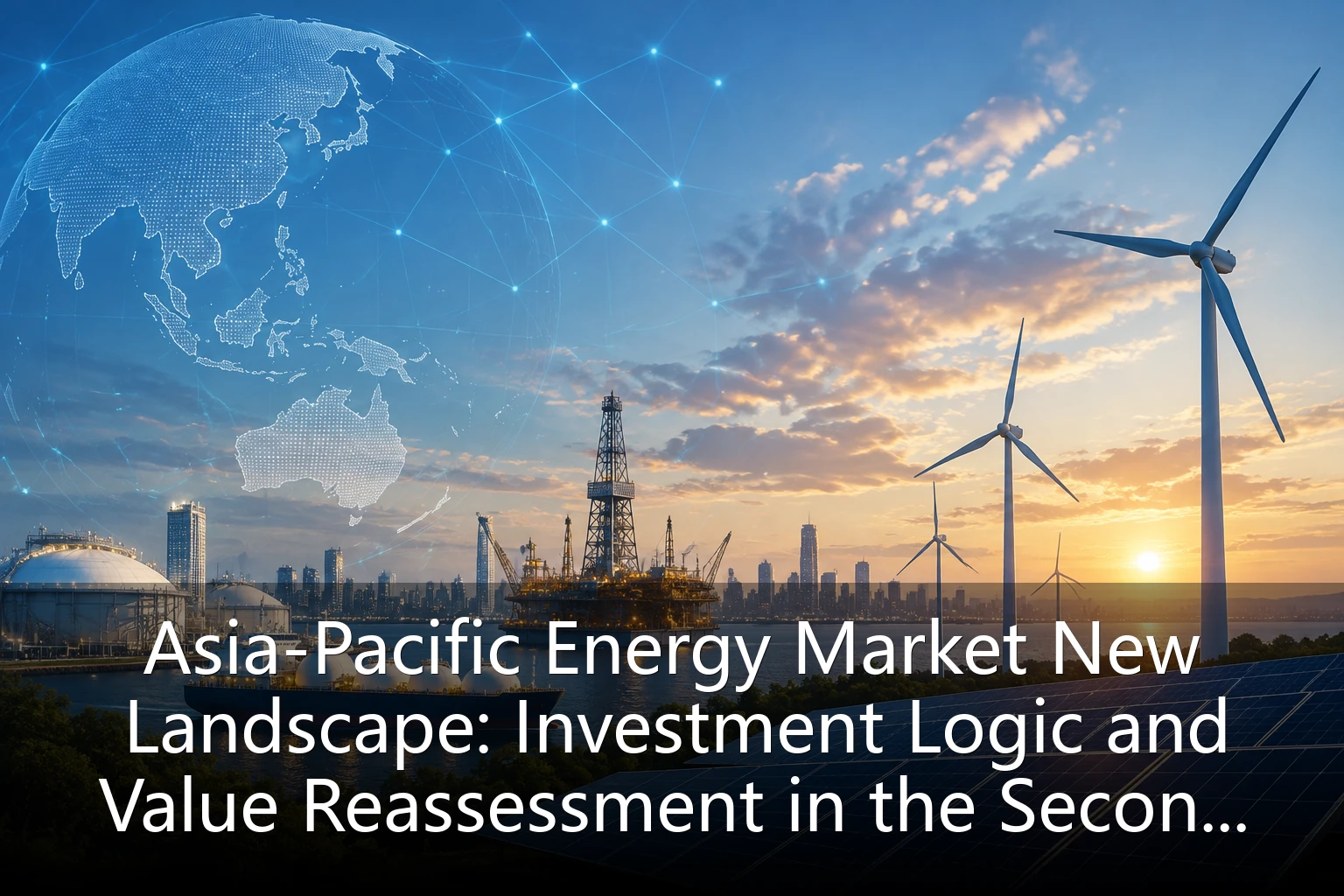
Asia-Pacific Energy Market New Landscape: Investment Logic and Value Reassessment in the Second Half of 2026
\nDuring the critical period of global energy transition, the Asia-Pacific region, as the global center of energy consumption and production, is experiencing unprecedented structural changes in its energy market. In the second half of 2026, with the continuous evolution of the geopolitical landscape, accelerated breakthroughs in energy technology, and the deepening of carbon neutrality goals, the Asia-Pacific energy market presents new investment logic and value reassessment directions. This article will deeply analyze from multiple dimensions such as market trends, investment opportunities, and risk challenges why investing in the Asia-Pacific energy market still possesses significant strategic value.
\n\nI. Key Driving Factors of the Asia-Pacific Energy Market
\nThe Asia-Pacific energy market is experiencing the intertwined influence of multiple transformative forces, which collectively shape the market landscape for the second half of 2026. Firstly, geopolitical risks continue to escalate, with the volatile situation in the Middle East significantly impacting global energy supply chains and pushing crude oil prices to seek a new balance amid fluctuations. Secondly, the economic recovery process in the Asia-Pacific region is uneven, with differentiated characteristics in energy demand from major economies such as China and India, bringing complexity and opportunities to the energy market. Thirdly, the energy transition is accelerating, with renewable energy installed capacity continuing to grow, making the integrated development of traditional and new energy an inevitable trend.
\n\nFrom a data perspective, energy investment in the Asia-Pacific region in the first half of 2026 shows a "dual-track parallel" feature: on one hand, investment in the traditional energy sector maintains resilience, especially in relatively clean fossil energy fields such as natural gas and LNG; on the other hand, renewable energy investment has reached a historic high, with investment growth rates in clean energy technologies such as solar, wind, and hydrogen significantly exceeding the global average. This differentiation in investment structure reflects deep-seated changes in the energy market and also provides investors with diversified allocation opportunities.
\n\nII. Integrated Development of Traditional and New Energy
\nThe integrated development of traditional and new energy has become the mainstream trend in the Asia-Pacific energy market. Under the constraints of carbon neutrality goals, traditional energy enterprises are accelerating business transformation and increasing investment in clean energy. Meanwhile, new energy enterprises are actively exploring collaborative development models with traditional energy, enhancing the stability and economic efficiency of energy systems through innovative means such as hybrid energy systems and energy storage technologies.
\n\nSpecifically, LNG's role as an important transitional energy is increasingly prominent in the Asia-Pacific region. On one hand, LNG can effectively replace coal and reduce carbon emission intensity; on the other hand, LNG and renewable energy have good complementarity, addressing the intermittency and volatility issues of renewable energy. In 2026, LNG infrastructure construction in the Asia-Pacific region is accelerating, especially with the application of innovative models such as Floating LNG (FRLNG) and small-scale LNG, providing new growth points for energy investment.
\n\nIn the new energy sector, the costs of renewable energy technologies such as photovoltaic and wind power continue to decline, achieving grid parity or even lower-than-grid parity. Meanwhile, energy storage technology has made breakthrough progress, with battery costs significantly decreasing, providing support for the large-scale application of renewable energy. As the ultimate clean energy, hydrogen energy investment enthusiasm in the Asia-Pacific region continues to rise, with the industrialization process of different technical routes such as green hydrogen and blue hydrogen accelerating.
\n\nIII. Investment Opportunity Analysis: Traditional Energy vs. New Energy
\nIn the second half of 2026, investment opportunities in the Asia-Pacific energy market show clear differentiated characteristics. In the traditional energy sector, the investment value of the natural gas industry chain is prominent, especially in upstream exploration and development, midstream LNG receiving terminals, and downstream distribution networks. With the continuous growth of natural gas demand in the Asia-Pacific region, especially the strong alternative demand for natural gas in power generation, industrial, and transportation sectors, the natural gas-related industry chain will迎来 long-term investment opportunities.
\n\nAlthough the crude oil market faces transformation pressure, it will maintain an important position in the medium to short term. Crude oil production companies with cost and technological advantages, as well as segments with unique value in the crude oil industry chain, will still have strong risk resistance and profitability. Meanwhile, the cross-border integration of crude oil and new energy, such as the application of Carbon Capture, Utilization, and Storage (CCUS) technology, also provides a transformation path for traditional energy enterprises.
\n\nIn the new energy sector, mature renewable energy technologies such as photovoltaic and wind power will continue to maintain a high growth trend, especially in regions and countries with superior resource endowments and strong policy support. As a key support for new energy development, energy storage technology will experience explosive growth in the second half of 2026, especially innovative technical routes such as electrochemical energy storage and compressed air energy storage. The hydrogen industry chain, with investment opportunities emerging across the entire chain from hydrogen production, storage to utilization, is gradually becoming apparent, especially in difficult-to-electrify fields such as industrial decarbonization and heavy transportation.
\n\nIt is worth noting that energy digitalization and intelligence have become new investment hotspots. The application of digital technologies such as artificial intelligence, big data, and Internet of Things in the energy sector continues to deepen, with innovative models such as smart grids, virtual power plants, and energy internet emerging endlessly. These digital solutions can not only improve the efficiency and reliability of energy systems but also create new business models and value growth points.
\n\nIV. Risk and Challenge Analysis
\nAlthough the investment prospects of the Asia-Pacific energy market are broad, investors still need to be vigilant about multiple risks and challenges. Firstly, geopolitical risks continue to exist, with situations in the Middle East and territorial disputes in the Asia-Pacific region potentially leading to energy supply chain disruptions and causing sharp price fluctuations. Secondly, policy uncertainty during the energy transition process, such as changes in carbon pricing mechanisms and renewable energy subsidy policies, may affect investment returns.
\n\nTechnology risks cannot be ignored either. New energy technology iteration is fast, and investment decisions may face technology route selection risks. Meanwhile, traditional energy assets may face stranded asset risks, where assets exited too early cannot recover investment costs, or exiting too late faces greater transformation pressure. In terms of market risks, factors such as energy price fluctuations and exchange rate changes can all affect the economics of investment projects.
\n\nEnvironmental and social risks are increasingly prominent. With the popularization of ESG (Environmental, Social, and Governance) investment concepts, energy projects face higher environmental and social responsibility requirements. Factors such as carbon footprint, water resource use, and community relations may all become important considerations in investment decisions. Additionally, the issue of just transition during the energy transformation process, such as the employment placement of workers in traditional energy industries, is also a topic that investors need to pay attention to.
\n\nV. Investment Strategy Recommendations
\nFacing the complex and changing Asia-Pacific energy market, investors need to formulate scientific investment strategies to grasp long-term value. Firstly, it is recommended to adopt a "core-satellite" investment strategy, which means using traditional energy assets with stable cash flows as core allocation, while allocating high-growth new energy assets as satellite allocation, to achieve a balance between risk and return.
\n\nSecondly, focus on industry chain integration opportunities. The integration of various links in the energy industry chain can create synergies and enhance overall competitiveness. Especially in emerging fields such as LNG and hydrogen energy, the integration of upstream and downstream of the industry chain can reduce costs, improve efficiency, and enhance market competitiveness.
\n\nThirdly, emphasize ESG investment concepts. Incorporating environmental, social, and governance factors into the investment decision-making process can not only reduce investment risks but also capture excess returns brought by ESG investments. Choosing companies and projects with good ESG performance can better adapt to the major trend of energy transition.
\n\nFourthly, grasp regional differentiation opportunities. There are significant differences in energy endowments, policy environments, and development stages among countries in the Asia-Pacific region. Investors need to formulate differentiated investment strategies according to the characteristics of different countries and regions. For example, resource-rich countries can focus on upstream resource development, while technologically advanced countries can focus on new energy technology innovation and application.
\n\nFinally, adopt a long-term investment perspective. Energy transition is a long-term process, and energy investment needs to be based on long-term considerations, avoiding the impact of short-term market fluctuations. The key to successful energy investment is to share structural opportunities brought by energy transition through long-term holding of quality assets.
\n\nVI. Conclusion: Long-term Value of Energy Investment
\nDespite facing multiple challenges, the Asia-Pacific energy market still possesses significant long-term investment value. Energy is the cornerstone of economic development and the driving force for human civilization progress. Under the constraints of carbon neutrality goals, the energy market is undergoing profound changes, and the integrated development of traditional and new energy will create huge investment opportunities.
\n\nIn the second half of 2026, the investment logic of the Asia-Pacific energy market is undergoing important changes: shifting from simply pursuing scale expansion to focusing on quality improvement, from a single energy structure to diversified energy coordination, and from short-term arbitrage to long-term value creation. Investors need to grasp this trend change and actively deploy structural opportunities brought by energy transformation under the premise of controllable risks.
\n\nOverall, investing in the Asia-Pacific energy market is not only a financial decision but also a strategic choice. By scientifically allocating energy assets, investors can not only obtain considerable investment returns but also contribute to promoting the energy transition in the Asia-Pacific region and achieving carbon neutrality goals, achieving a win-win of economic benefits and social value. In the context of the great era of energy transformation, energy investment will continue to play an important role, creating long-term and stable returns for investors.