Oil Price Game: Iran's Threat and the Strategic Dilemma of Global Energy Security
Introduction
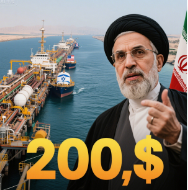
In July 2026, geopolitical tensions in the Middle East reignited. The Iranian government publicly threatened that if the US and Israel continue to pressure over the nuclear issue and regional affairs, Tehran would push international oil prices to $200 per barrel, launch consecutive military strikes against both countries, and block the Strait of Hormuz—the world's most critical oil transport chokepoint. In response, the International Energy Agency (IEA) quickly announced that member countries would jointly release 400 million barrels of strategic petroleum reserves to calm market panic. This event pushed global energy security and geopolitical strategic games to a new critical point.
Iran's 'Oil Nuclear Weapon': Feasibility Analysis of $200 Oil
Iran's threat is not baseless. As OPEC's third-largest oil producer, Iran's daily crude oil exports of about 2.5 million barrels may be less than Saudi Arabia's, but its geographic location controlling the Strait of Hormuz gives it a unique strategic lever. The strait handles about 20% of global oil transportation; if blocked, about 17 million barrels of oil flow per day would be cut. Historically, during the Iran-Iraq war in the 1980s, tanker wars caused severe oil price fluctuations; the 2019 attack on Saudi oil facilities sent Brent crude soaring 15% in a single day.
From a supply-demand perspective, pushing oil prices to $200 is not impossible. If the blockade lasts more than two weeks, global inventories will rapidly deplete, and panic buying will inevitably drive futures prices up. However, this strategy carries huge risks: Iran's own economy is highly dependent on oil exports, meaning a blockade would cut off its own revenue; and a $200 price would severely damage global oil demand, potentially triggering an economic recession that would eventually backfire on Iran. Therefore, this threat is more of a bargaining chip aimed at forcing the US and Israel to make concessions on the nuclear deal and sanctions.
Strategic Reserve Release: The 'Firefighting' Effect and Limitations of 400 Million Barrels
The IEA's response is unprecedented. The release of 400 million barrels of strategic reserves is about 15% of the total reserves held by IEA member countries, exceeding the 120 million barrels released during the 2022 Russia-Ukraine conflict. This measure aims to send a clear signal to the market that major consuming countries have sufficient buffer capacity and will not sit idly by while oil prices spiral out of control.
In the short term, this can quickly increase market supply and lower spot premiums. Referring to the 2022 experience, strategic reserve releases combined with interest rate hike expectations had brought Brent crude from $120 down to the $90 range. However, the release of 400 million barrels is not without cost: first, US strategic petroleum reserves have fallen to a 40-year low, and further releases will weaken the ability to respond to sudden disruptions in the future; second, the release requires gradual market entry through commercial sales or exchange agreements, resulting in a time lag; more importantly, it cannot resolve the geopolitical risk itself—as long as the blockade threat remains, the risk premium is difficult to eliminate.
The 'Powder Keg' of the Persian Gulf: Potential Paths to Military Conflict
Iran's threat to continuously attack US and Israeli targets has sharply heightened security tensions in the Middle East. Analysts point out that Iran may launch asymmetric attacks: using proxy forces to attack northern Israel, or deploying missiles and drones in the Red Sea and Gulf of Oman to harass commercial shipping. More seriously, if Israel or the US launches a preemptive strike on Iran's nuclear facilities, it would directly trigger a full-scale war, leading to a complete halt in Persian Gulf shipping.
Worryingly, both sides have shown a tendency to "cross red lines." Iran recently tested hypersonic missiles, while Israel participated in the "Blue Flag" joint military exercise with the US, simulating long-range strikes. This spiral escalation is highly prone to getting out of control due to miscalculation. Should direct military conflict break out, oil prices breaking through $150 in the short term is almost a consensus, and strategic reserve releases can only delay, not prevent, this process.
Historical Lessons: Warnings from 1973 and 2022
Looking back at history, the 1973 Arab oil embargo caused oil prices to soar from $3 to $12, triggering global stagflation; after the 2022 Russia-Ukraine conflict, the energy crisis forced many countries to restart coal and nuclear power. Today, the intensity of Iran's threat is similar to 1973, but the global energy structure has changed dramatically: the shale revolution has made the US a net exporter, renewable energy's share has significantly increased, and electric vehicle penetration continues to grow. However, the Middle East remains the "regulating valve" of global oil, and any regional conflict will be amplified through financial markets into systemic risk.
Conclusion: From 'Oil Weapon' to the Urgency of 'Energy Transition'
This crisis once again proves that oil is not just a commodity but a sharp tool in geopolitical games. Iran's $200 threat and the IEA's 400 million barrel release are essentially a hedge of forces on both the supply and demand sides. But short-term emergency measures cannot replace long-term strategies: on one hand, consuming countries need to accelerate strategic reserve expansion and establish diversified import sources to reduce dependence on a single strait; on the other hand, the world must achieve breakthroughs in renewable energy, energy storage technology, and grid interconnection to completely break free from the "resource curse" of fossil fuels.
As history shows, every oil crisis forces an energy revolution. If this crisis can serve as a catalyst to accelerate clean energy investment, then the $200 price may become the last warning for humanity's move toward carbon neutrality.
Keywords: Iran Threat; $200 Oil; Strategic Petroleum Reserves; Strait of Hormuz; Energy Security; Geopolitical Risk